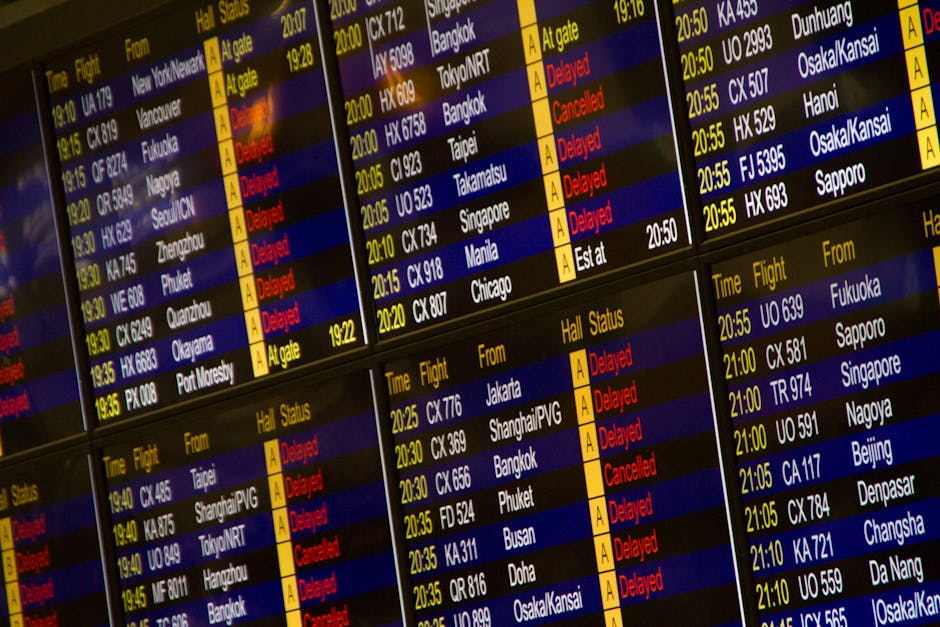
Hey fellow travelers — I’ve stared at a departure board that just keeps changing, and it’s brutal. This guide walks you through what to do step by step when your flight is delayed for hours, plus when EU-style compensation is actually likely.
First 60 minutes: get safe, get informed
Delays don’t always behave logically. The key is to stop “winging it” and start building a timeline while you’re still at the airport (or right when you get notification).
Get status fast (not vibes)
If you can, confirm the situation from more than one place—because departure boards and apps sometimes disagree.
- Check the airline app/website for the live status, gate/terminal changes, and the updated estimated departure time
- Screenshot the delay details (departure time, “delayed by” minutes, any reason given)
- Verify whether you’re still on the same flight number/route (code-shares change the story)
Lock in your timeline and contact options
You’ll thank yourself later when you’re trying to prove what happened.
- Save your booking confirmation (email/PDF) and the passenger info you’ll need for claims
- Use the airline’s in-airport desk and/or official chat (if it exists) and note the agent’s name or ticket/reference number
- Keep your phone charged or bring a portable charger—dead batteries make you slower to act
Decide what you want from the delay
There’s a difference between “surviving the wait” and “getting your money back for the part you lost.”
- If you’re already losing an entire day (or missing a connection), ask about rebooking to the next viable option
- If the delay is looking long enough to kill your plans, ask about refund vs re-route early rather than at the end
- If there’s any chance you need hotels/transport, ask immediately what the airline will reimburse (and how)
Documentation that actually matters (so your claim doesn’t stall)
Compensation claims tend to fail for boring reasons: missing proof, unclear timelines, or no evidence of expenses. The fix is straightforward—collect the right stuff in the right format.
Capture proof while you’re still inside the delay
Don’t wait until everything is “done.” You can usually still get better information at the airport.
- Save boarding passes, itinerary/confirmation emails, and any rebooking emails the airline sends
- Screenshot departure board updates and in-app notifications showing the original scheduled departure vs the delayed departure
- Collect receipts for anything the airline doesn’t automatically cover (meals, hotel, local transport)
- Request a written/official explanation of the delay when possible (even if it’s short—“ATC” or “technical issue” matters)
Keep copies you can upload later
Most people think screenshots are enough. They’re not always.
- Store PDFs/images in one folder named with your flight number and departure date
- If you claim EU-style compensation, keep the exact flight number, route, booking reference, and passenger name as listed on the ticket
What to ask for during a hours-long delay (airport or customer service)
Airline support depends on your ticket, the route, and what country you’re departing from—but there are still common levers. The goal here is to get the airline to respond in writing and log what they promise.
Get the basics sorted: rebooking, refund options, and communications
Even when you can’t force compensation immediately, you can often force clarity.
- Ask what rebooking options exist (next flights, alternate airports, and whether they require extra payment)
- Ask whether you can get a refund if you choose not to travel, and how the refund will be processed
- Ask for a written record of what they’ll do for you (voucher/hotel/rebooking notes)
Request the support that covers your “lost comfort”
Airlines often provide meals, refreshments, and sometimes accommodation when delays drag on—especially if it turns into an overnight situation.
- If meals/restaurants are part of the deal, ask for meal vouchers or reimbursement in a way you can prove later
- If you might need an overnight stay, ask whether hotel accommodation is provided and what conditions apply for reimbursement
EU-style compensation: when it’s realistic (and when it’s not)
Here’s the blunt truth: whether you get EU-style compensation is less about “how late it was” and more about “what caused it.” Still, there are patterns.
The typical EU-style baseline
EU261-style compensation is commonly associated with flights departing the EU/EEA/Switzerland (or operated by an EU/EEA airline in certain cases), and it often kicks in when delays are at least 3 hours at arrival.
- Delay is usually treated similarly to cancellation for compensation when it reaches the threshold (often 3+ hours), but expenses/reimbursements are a separate category
- Compensation amounts tend to be tiered by flight distance (often cited as roughly €250 / €400 / €600), while exact eligibility depends on the details
The reason for the delay is the make-or-break factor
Airlines may deny claims by saying the cause was “extraordinary circumstances.” Sometimes that’s fair; sometimes it’s just their preferred wording.
- Weather and certain air-traffic management constraints are commonly treated as possible extraordinary circumstances (but you’ll still want specifics)
- Many “technical issues” are argued as extraordinary only in narrow cases; routine maintenance problems are often disputed by claim outcomes
- Strikes and staffing issues can go either way depending on who/what caused the disruption and how the airline argues it was beyond control
How to interpret what the airline tells you
When the airline gives you a reason, don’t accept it blindly—use it to decide your next move.
In practice, you’re trying to match their explanation to what typically gets accepted as extraordinary vs what tends to be treated as within airline control. If their reason is vague (“operational reasons”), ask for a clearer written explanation. If they can specify the cause (e.g., “ATC delay” with a time window, or “technical defect on aircraft”), that helps you assess your odds.
If the airline doesn’t fix it: escalation and claims
If you’re asking for rebooking/refunds/support and still not getting a response, switch from “chatting” to documenting. Then move to a formal complaint.
Use a structured complaint (and attach everything once)
This is where delays turn into paperwork. Keep it simple: timeline, what you asked for, what you received (if anything), and what you want.
- Write a short, factual message: flight number, booked departure/arrival, actual times, and the delay duration you’re claiming
- Attach proof in one go: screenshots, boarding pass, receipts, and any airline messages showing what they promised
Consider claim help if you’re stuck (optional)
If you don’t want to fight the process alone—or the airline’s responses are slow and repetitive—third-party assistance can be useful. I’ve personally used AirHelp for some delays, and the main value was handling the claim paperwork and follow-ups when I was too tired to keep chasing.
One honest note: these services may involve fees or different payout rules, and they can’t magic away “no compensation due to extraordinary circumstances.” They’re a tool when the airline process becomes a grind.
Final thoughts: stay calm, then get specific
When your flight is delayed for hours, you’ll feel like nothing is in your control. But you do control your speed, your documentation, and how clearly you communicate what you’re asking for.
If you do just three things, make them these: capture proof early, request rebooking/refund/support while you’re still there, and only then decide whether compensation is worth pursuing based on the delay cause. That approach won’t guarantee a win—but it massively improves your odds and reduces the “missing information” rejections.